What are bed bugs?
Bed bugs are small parasitic insects from the Cimicidae family that feed exclusively on the blood of warm-blooded hosts, with a strong preference for humans. They have lived alongside people for thousands of years and are now one of the most common indoor pests in the UK. Adults are roughly the size and shape of an apple pip, reddish-brown in colour, and entirely wingless. They hide during the day in seams, cracks and joinery close to where people sleep, then emerge at night to feed. They reproduce quickly, with a single female laying hundreds of eggs in her lifetime, which is why early professional bed bug treatment matters so much.
What do bed bugs look like?
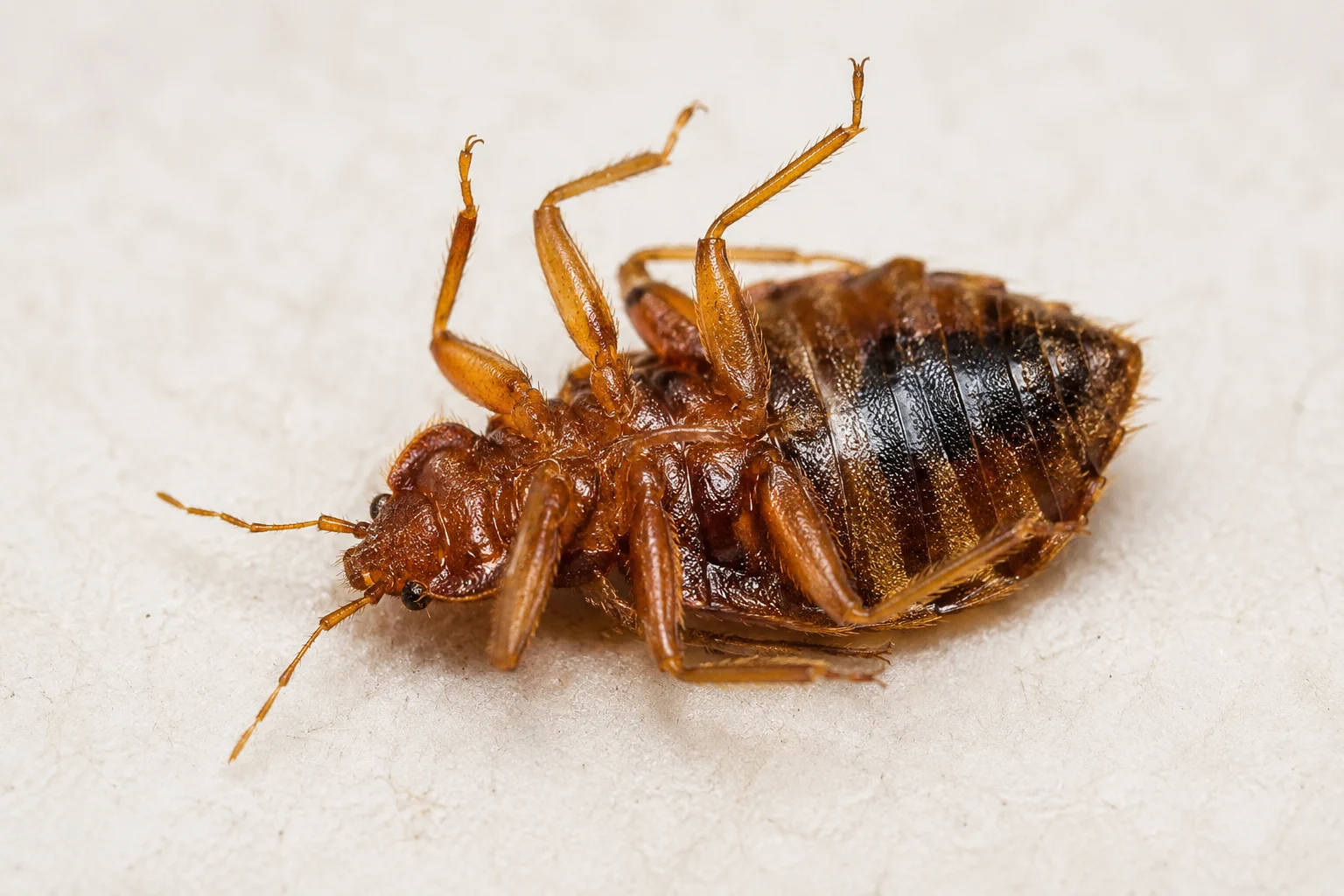
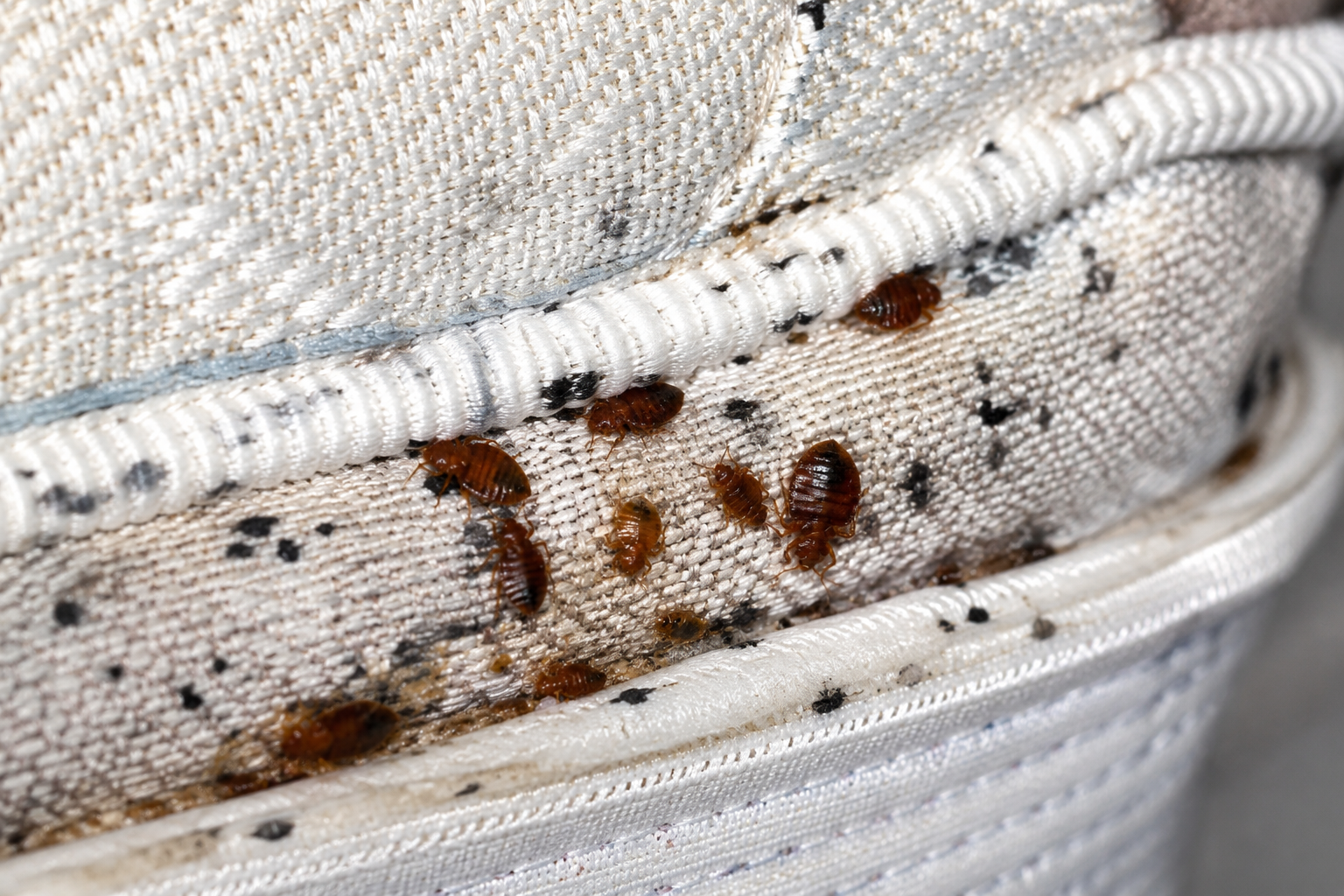
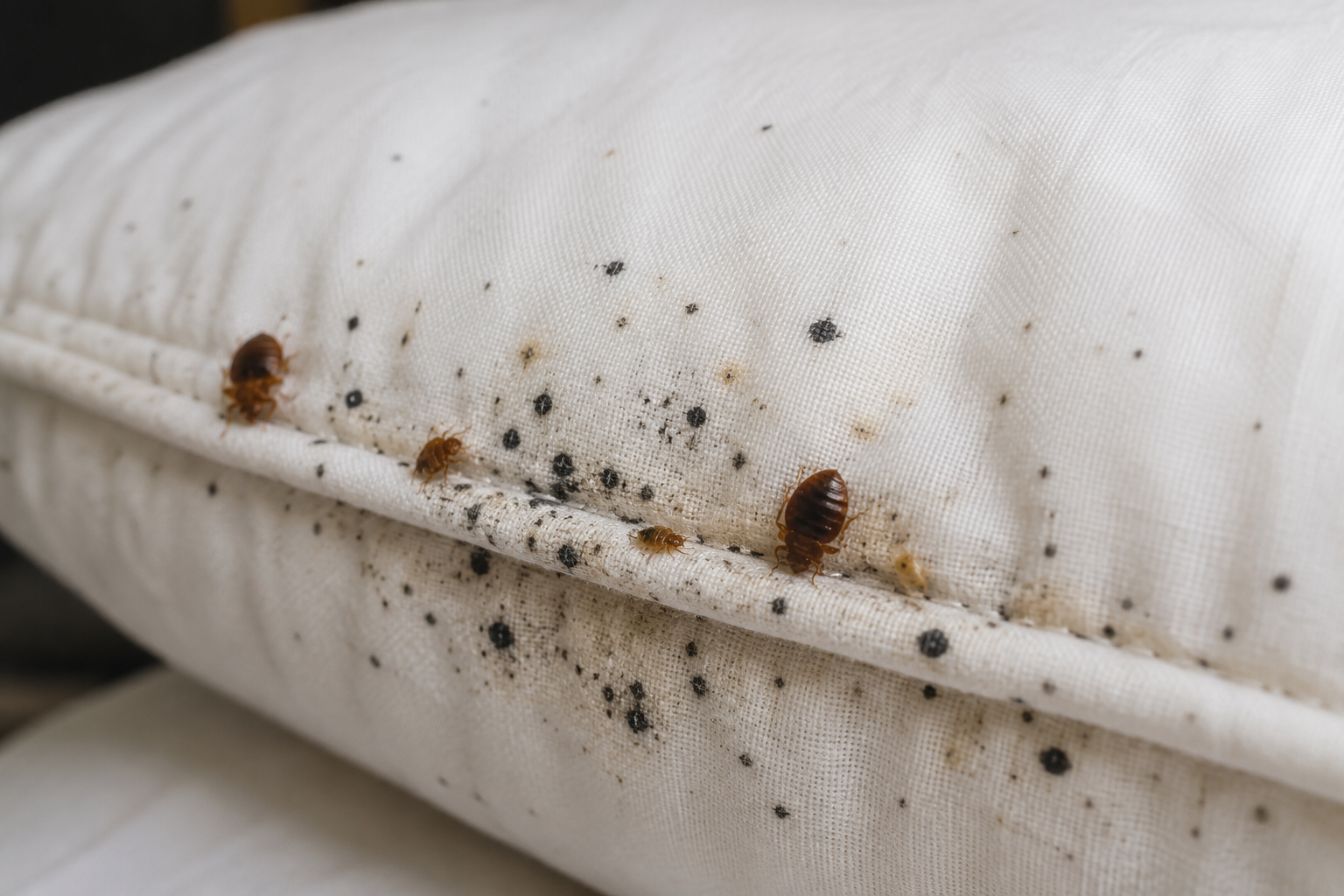
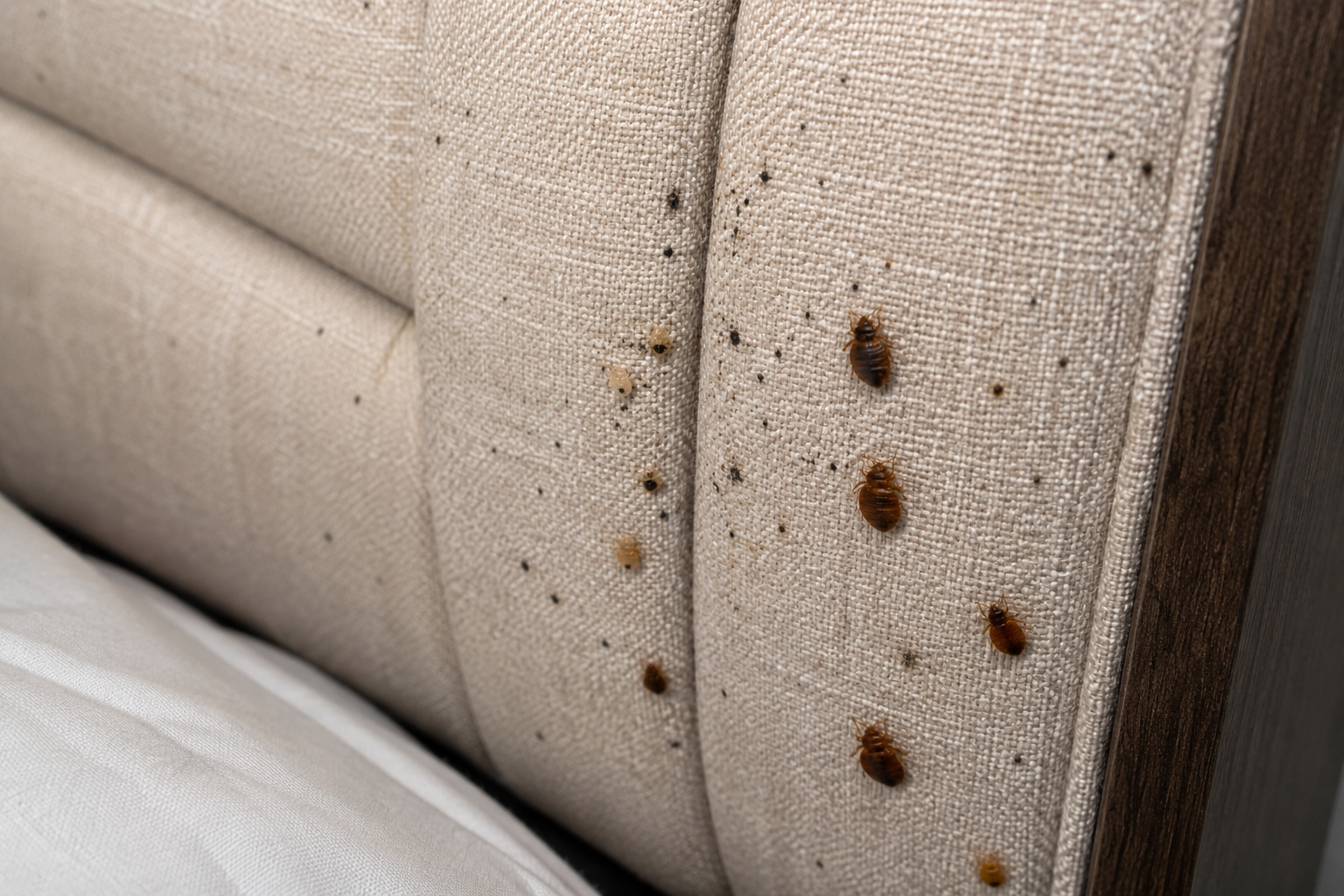
Adult bed bugs are flat, oval and roughly 4–5mm long, similar to a small apple pip. Before feeding they appear reddish-brown and almost translucent at the edges; after a blood meal they become darker, plumper and more elongated. Their backs show short, fine hairs and clear segmented bands. Young bed bugs, known as nymphs, are smaller, paler and almost yellow when unfed, which makes them very easy to miss. Eggs are around 1mm long, pearly white and often glued in clusters into seams or cracks. Most homeowners spot the dark faecal spots they leave behind long before they see a live insect.
How big are bed bugs?
A fully grown adult bed bug measures roughly 4–5mm in length and around 1.5–3mm wide, depending on whether it has recently fed. Newly hatched nymphs are tiny, about 1mm, and progress through five growth stages, becoming larger and darker after each blood meal. Eggs are smaller still at around 1mm and are very difficult to spot without a torch and magnifier. Because of their flattened body shape they can squeeze into gaps the width of a credit card, which is why DIY inspections frequently miss them. Professional bed bug exterminators use bright torches and probing tools to find every life stage.
Can bed bugs fly?
No, bed bugs cannot fly. Unlike many household pests they have no functional wings, only small wing pads that never develop into true wings. They also cannot glide or drop deliberately from ceilings. Instead, they travel by crawling and by hitchhiking on luggage, clothing, bedding, second-hand furniture and other objects that move between rooms or buildings. Despite being flightless, they can cover surprising distances overnight while searching for a host, which is how they spread through flats, houses and hotels. Knowing they cannot fly is useful because it means sealing gaps and inspecting belongings genuinely helps reduce the risk of bringing them home.
Can bed bugs jump?
Bed bugs cannot jump. They have no specialised hind legs for leaping and rely entirely on crawling. This is a key way to tell them apart from fleas, which jump in a sudden spring when disturbed, and from carpet beetles, which scuttle quickly across hard floors. If you see an insect leaping from your mattress when you pull back the sheet, it is far more likely to be a flea than a bed bug. Bed bugs move slowly and deliberately, usually at night, climbing up bed legs and across linen to reach a sleeping person. Their stealthy movement is one reason infestations often go unnoticed.
Do bed bugs bite?
Yes, bed bugs bite, and biting is the only way they feed. They use a slender beak to pierce the skin and draw blood, usually while you are asleep and least likely to disturb them. The bite itself is painless because saliva contains a mild anaesthetic and an anti-clotting agent. Most people only realise they have been bitten hours or even days later when itchy red marks appear, often in lines or small clusters on the arms, neck, back or legs. Repeated bites over weeks are a strong indicator of an active infestation and should prompt a professional bed bug inspection and heat treatment.
What do bed bug bites look like?
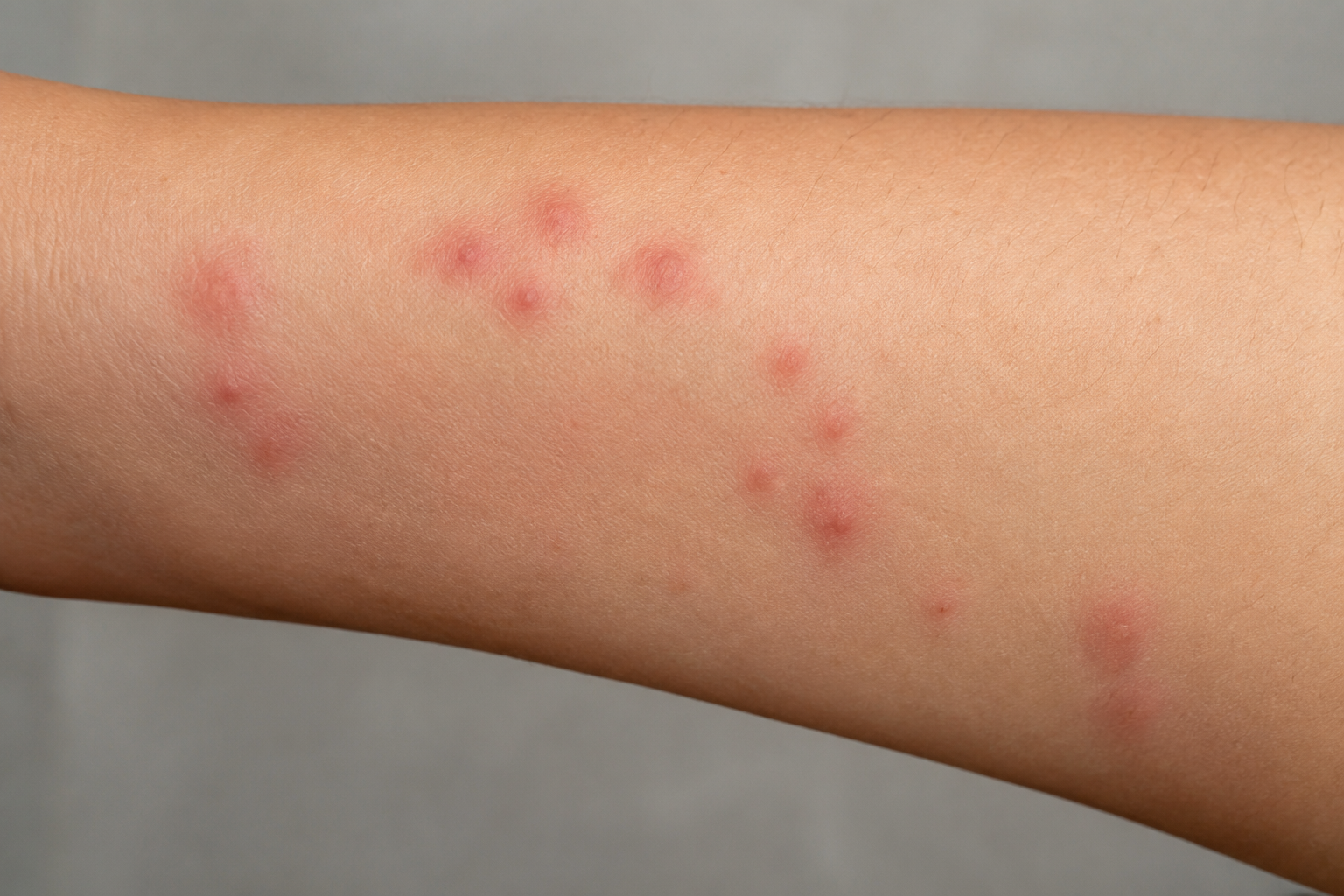
Bed bug bites typically appear as small, raised red bumps with a darker centre, often in a straight line, zigzag or small cluster of three or four. They favour skin that is exposed during sleep, such as the face, neck, shoulders, arms and lower legs. Reactions vary widely: some people develop firm itchy welts, others see flat pink marks, and a few have no visible reaction at all. The pattern of multiple bites along the same limb is one of the strongest clues, because mosquitoes and fleas rarely leave such regular trails. If new bites keep appearing each morning, an active infestation is the likeliest cause.
How long do bed bug bites last?
Most bed bug bites fade within one to two weeks, although heavily scratched bites can take longer and may leave temporary marks on darker skin tones. The itch is usually most intense for the first two or three days and then settles gradually as the body absorbs the saliva proteins that caused the reaction. People with sensitive skin or repeated exposure may experience larger welts that linger for several weeks. Cool compresses, antihistamines and mild hydrocortisone cream from a pharmacy generally help. If bites continue to appear, treating the symptom is not enough; the underlying infestation needs proper bed bug control.
Why do some people react to bed bug bites and others do not?
Reactions depend almost entirely on the body's immune response to bed bug saliva. Some people produce histamine quickly and develop obvious red welts within hours, while others take days to react or never visibly react at all. Children, older adults and anyone with sensitive skin tend to react more strongly, while around one in five people show no visible bites whatsoever. This is why one partner can wake covered in marks while the other appears untouched, even though both are being bitten. Lack of bites is not proof of a clean property, so professional inspection is essential when bed bugs are suspected.
Can bed bug bites appear days later?
Yes. While some people develop marks within a few hours, others may not see any reaction for several days, occasionally up to two weeks after the actual bite. This delayed onset happens because the immune system needs time to recognise the proteins in bed bug saliva. The delay can make it very difficult to pinpoint where bites were picked up, which is why bed bugs are often blamed on hotels long after the real source was a sofa, taxi or visitor. If new bites keep appearing in the same room over time, an active infestation in the home is almost certainly responsible.
Do bed bug bites itch?
Most bed bug bites itch, sometimes intensely, although the strength of the itch varies from person to person. The itching is caused by an allergic reaction to proteins in the bug's saliva rather than by the puncture itself. For many people the irritation peaks two to three days after the bite and then slowly fades. Scratching can break the skin and lead to secondary bacterial infections, so it is best to keep nails short and apply a soothing antihistamine cream. Persistent itching across multiple nights almost always points to repeated feeding, which means the infestation is still active and needs professional bed bug treatment.
Where do bed bugs hide?
Bed bugs hide within a few metres of where people sleep. The most common hiding places are mattress seams, bed frame joints, headboards, bedside drawers and the underside of slatted bases. As an infestation grows they spread to skirting boards, curtain hems, behind picture frames, inside electrical sockets and within upholstered furniture. They prefer narrow, dark cracks where their flat bodies fit snugly, and they leave behind dark faecal spots, shed skins and tiny pale eggs glued into seams. A professional bed bug exterminator knows exactly where to look, which is why DIY inspections often miss the main harbourage.
When are bed bugs most active?
Bed bugs are nocturnal and are most active in the small hours of the morning, typically between 1am and 5am, when their host is in the deepest stages of sleep. They are drawn out by warmth, carbon dioxide and body odour, so anyone sleeping in the room becomes a target. During the day they retreat to dark, undisturbed harbourages and remain still, which is why infestations are easy to miss until bite counts rise. If you suspect bed bugs, switching the light on suddenly in the middle of the night and inspecting bed seams is one of the most reliable home checks.
How often do bed bugs feed?
A healthy adult bed bug typically feeds once every five to ten days, although they can feed more often when a host is consistently available. A full meal takes between five and ten minutes, after which the bug returns to its harbourage to digest, mate and lay eggs. Nymphs need a blood meal before each of their five growth stages, so they feed slightly more frequently than adults. Because they only emerge briefly and feed silently, many people share a bed with bed bugs for weeks before realising. Professional heat treatment for bed bugs ends this cycle in a single visit.
How long can bed bugs survive without feeding?
Adult bed bugs are remarkably resilient and can survive several months without feeding in normal indoor conditions. In cooler, undisturbed environments such as empty flats, lofts or stored furniture, some adults can survive close to a year. Nymphs are less hardy but can still last weeks between meals. This is why leaving a property empty rarely solves an infestation: when you return, the surviving bugs simply start feeding again. It also means second-hand sofas or mattresses that have been in storage for months can still harbour live insects, which is one of the most common sources of new infestations.
What attracts bed bugs?
Bed bugs are attracted by three things: the carbon dioxide we exhale, our body heat, and certain skin chemicals such as kairomones. They are not drawn by dirt, food crumbs or poor hygiene, which is why even immaculate homes and five-star hotels can suffer infestations. They will travel several metres from their hiding place to reach a sleeping person, following these cues with surprising accuracy. The single biggest risk factor is contact with another infested environment, whether that is a hotel room, taxi seat, train carriage, cinema or second-hand item of furniture brought into the home.
How do bed bugs spread?
Bed bugs spread almost entirely by hitchhiking. They cling to luggage, handbags, coats, bedding, laptop bags and second-hand furniture, then crawl off into a new harbourage once the item is settled in another property. They do not fly or jump, but they walk freely between rooms and can move between adjoining flats through service ducts, plumbing voids and gaps around skirting boards. This is why infestations often appear in multi-occupancy buildings and why a single returning traveller can introduce them to a whole household. Prompt professional bed bug treatment stops a small problem becoming a building-wide one.
Can bed bugs travel between flats?
Yes. In blocks of flats and HMOs, bed bugs frequently move between units by crawling through wall cavities, around pipework, along skirting boards and via shared lofts. They will also travel on residents, visitors and shared laundry. This is why a single infested flat can become a building-wide problem if treatment is delayed. Effective bed bug control in shared buildings often involves treating neighbouring units at the same time and sealing entry points where possible. If you live in a flat and suspect bed bugs, telling your landlord or managing agent early gives the building the best chance of containing the spread.
Can visitors bring bed bugs into my home?
Yes, visitors are a common, often overlooked source of new infestations. Bed bugs and their eggs can travel on coats, handbags, overnight bags and even shoes from another infested property. House guests staying overnight pose the highest risk, because bugs have time to crawl out of luggage and into your bedroom furniture. You do not need to stop welcoming people, but if a visitor has recently had bed bugs it is sensible to keep coats off beds and inspect any guest room afterwards. Professional bed bug inspections can confirm whether anything has been introduced before it becomes a full infestation.
Can bed bugs travel in luggage?
Luggage is by far the most common way bed bugs travel long distances. They climb into the seams, zips and corners of suitcases in infested hotel rooms, then ride home undisturbed. Hard-shell cases offer fewer hiding places than fabric bags but are not bed-bug proof. After any trip, it is sensible to unpack outside the bedroom, wash clothing on a hot wash and tumble dry, and inspect the case before storing it. If you have recently returned from somewhere bed bugs were suspected, a precautionary professional inspection is a small price for genuine peace of mind.
Can bed bugs travel in clothing?
Yes. While bed bugs do not live on people the way head lice do, they will happily hide in folds, pockets and seams of clothing, especially items left on infested beds, sofas or floors. From there they can be carried into a new home, hotel room or workplace. This is why outbreaks sometimes appear in offices, schools and cinemas: a single bug travels in on a coat and is brushed off onto upholstered seating. Washing clothes at 60°C and tumble drying on a high heat for 30 minutes reliably kills any bugs or eggs hidden in fabric.
Can bed bugs spread through walls?
Bed bugs cannot chew through solid walls, but they easily travel through the small gaps that exist in almost every building. They follow electrical conduit, plumbing chases, cavities behind skirting boards, gaps around radiator pipes and the voids above suspended ceilings. In flats, this means a neighbour's infestation can quietly cross into your property without anyone opening a door. Sealing visible gaps with decorator's caulk helps slow the spread, but once bugs are in the structure, only thorough professional bed bug treatment, ideally with heat, will reliably remove every life stage in one go.
Can bed bugs live in sofas?
Sofas are one of the most common secondary harbourages for bed bugs, especially in households where people sometimes sleep or nap on them. Bugs hide deep within the frame, under cushions, along zips, inside the dust cover beneath the base and within recliner mechanisms. Fabric sofas usually harbour larger populations than leather, but no upholstered furniture is immune. Because of the complex internal structure, sofas are very difficult to treat with sprays alone. Whole-room heat treatment penetrates the entire frame to the core temperature needed to kill bugs and eggs, which is why it is the preferred method for upholstered furniture.
Can bed bugs live in carpets?
Bed bugs do not live within the pile of a carpet the way dust mites do, but they frequently hide along the very edges, particularly under the gripper rods and within the join between the carpet and the skirting board. They use these channels to travel between the bed and other rooms and to lay eggs in undisturbed seams. Vacuuming alone will not remove eggs glued into these gaps. During heat treatment we lift carpets where necessary and heat the entire room to a core temperature that penetrates underlay and floorboards, eliminating bed bugs and eggs in a single visit.
Can bed bugs live in wardrobes?
Yes. Wardrobes, chest of drawers and bedside cabinets are classic secondary harbourages, particularly once a bedroom infestation is established. Bed bugs hide in the joints, screw holes and drawer runners, and they can also shelter in folded clothing that has been left undisturbed. Wooden furniture provides ideal cracks for egg laying, while flat-pack pieces often have hollow voids that are difficult to inspect. During a professional heat treatment we open every drawer and door so hot air can circulate through the entire piece, ensuring bugs and eggs hidden in the joinery reach a lethal core temperature.
Can bed bugs live in curtains?
Bed bugs sometimes hide in heavy curtains, particularly in the hems, pleats and pelmets, and they may also shelter in the curtain track or fitting above. Lightweight curtains are less likely to be infested than thick, lined drapes that touch the floor or bed. Removing curtains for a hot wash and tumble dry, or heating the whole room with professional equipment, is the most reliable way to deal with them. Always inspect the rail and surrounding wall once curtains are taken down, as bugs may have used the fittings as a route between the window area and the bed.
Can bed bugs live in electrical sockets?
Yes, electrical sockets and switch plates are a well-known hiding place for bed bugs, especially in established infestations. The warm, dark cavities behind faceplates provide an ideal harbourage, and bugs can travel along the wiring runs from room to room. For safety reasons sockets must never be sprayed with insecticide. Professional heat treatment is the safest and most effective option because hot air circulates through the cavities without damaging the wiring. Our technicians often remove faceplates during inspection and treatment to confirm that bugs hidden inside the back boxes have been reached by the heat.
Can bed bugs live behind skirting boards?
Skirting boards are a classic secondary harbourage, particularly where they have shrunk away from the wall or where the gap above the floor has never been sealed. Bugs and eggs collect in the narrow void, sheltered from cleaning and most spray treatments. In older properties with timber floors this gap may run the full length of the room, allowing bugs to travel unseen. Heat treatment is ideal in these situations because hot air reaches into the void without the need to lift the skirting. After treatment we recommend sealing visible gaps with caulk to reduce future harbourage.
Can bed bugs live in lofts?
Bed bugs occasionally find their way into lofts, particularly when infested furniture, mattresses or suitcases have been stored there. They are far less common in lofts than in bedrooms, but they can survive for months in stored items waiting for a host to return. If you suspect bed bugs in a loft, avoid bringing stored items down into living spaces until they have been inspected or heat treated. Whole-room heat treatment can be applied to the loft space itself or to individual items inside a heat chamber, ensuring nothing infested is reintroduced into the rest of the home.
Can bed bugs live in kitchens?
Bed bugs prefer to live near where people sleep, so kitchens are rarely the primary site of an infestation. However, in heavily infested properties they will spread into adjoining rooms, and a kitchen sofa, dining bench or seating booth can provide a secondary harbourage. They do not feed on food and are not attracted by crumbs or grease, so a clean kitchen offers no specific protection. If bugs are found in a kitchen it is usually a sign of an advanced infestation elsewhere in the property, which makes prompt professional bed bug treatment particularly important.
Can bed bugs live in bathrooms?
Bathrooms are an unusual location for bed bugs because they offer few of the conditions bugs prefer: little upholstery, hard cleanable surfaces and no host sleeping nearby. Occasional sightings do occur, usually around towel cupboards, laundry baskets or wooden bathroom furniture, and almost always in homes with a significant infestation elsewhere. Bugs may be carried in on dressing gowns or towels left in the bedroom. Finding a bed bug in a bathroom should always trigger a thorough inspection of the bedrooms and living rooms, where the breeding population is almost certainly hiding.
How do hotels get bed bugs?
Hotels get bed bugs almost entirely from guests. Travellers unwittingly bring bugs in luggage from a previous hotel, home or transport, and the bugs crawl out into the new room. Even immaculate five-star properties are at risk, because the issue has nothing to do with cleanliness and everything to do with the constant turnover of guests. Well-run hotels train staff to spot signs during housekeeping and bring in professional bed bug heat treatment quickly when something is found, often treating the affected room and its neighbours to prevent spread. A single overlooked room can quickly become a building-wide problem.
How can I avoid bed bugs while travelling?
When you arrive in a hotel room, put your luggage in the bathroom while you inspect. Pull back the sheets and check the mattress seams, headboard and bedside drawers for live bugs, shed skins or dark faecal spots. Keep your case on a luggage rack away from the bed, and never leave clothing on upholstered chairs. On returning home, unpack outside the bedroom if possible, wash clothing on a hot cycle and tumble dry, and inspect the case before storing. These simple habits dramatically reduce the chance of bringing bed bugs back from a trip.
What should I do if I find bed bugs in a hotel?
Stop using the bed immediately and seal anything that has touched it inside a plastic bag. Notify reception calmly, ask for a different room as far from the affected one as possible, and request that staff inspect any new room before you move in. Do not move belongings directly into the new room; isolate clothing and luggage where you can. On returning home, hot wash and tumble dry every item from the trip, and inspect the suitcase thoroughly. If bites continue at home over the following weeks, arrange a professional bed bug inspection without delay.
Can bed bugs come home in suitcases?
Yes, suitcases are the single most common way bed bugs travel back from a trip. Bugs and eggs hide in the seams, zips, wheel housings and internal pockets, then crawl out once the case is back in the bedroom. Hard cases offer fewer hiding places than soft fabric ones but are not immune. After any trip, unpack outside the bedroom if you can, hot wash clothing, and inspect the case in good light before storing it. If you have any doubt, a professional inspection is the most reliable way to confirm whether anything came home with you.
What is bed bug heat treatment?
Bed bug heat treatment is a chemical-free method of eradicating bed bugs by raising the air temperature of an entire room or property to a level that is lethal to every life stage of the insect. Industrial heaters, high-powered fans and wireless sensors are used to deliver and monitor the heat. Because bugs cannot evolve resistance to temperature the way they have to insecticides, heat reliably kills adults, nymphs and eggs in a single visit. Professional heat treatment for bed bugs is widely regarded as the gold-standard option for fast, complete eradication, particularly where infestations have already resisted spray treatments.
How does heat treatment work?
We position industrial heaters and high-volume fans around the treatment area, then circulate hot air until the entire room reaches a lethal temperature. Wireless probes are placed at the coolest points, such as inside mattresses, drawers and behind headboards, so we can confirm bed bugs cannot survive anywhere. The air is held at temperature for at least 90 minutes, ensuring heat penetrates every harbourage. Throughout the treatment our technicians actively work the room, moving cushions and opening drawers to expose hidden pockets. Once the cycle is complete the property cools naturally and is safe to use again the same evening.
What temperature kills bed bugs?
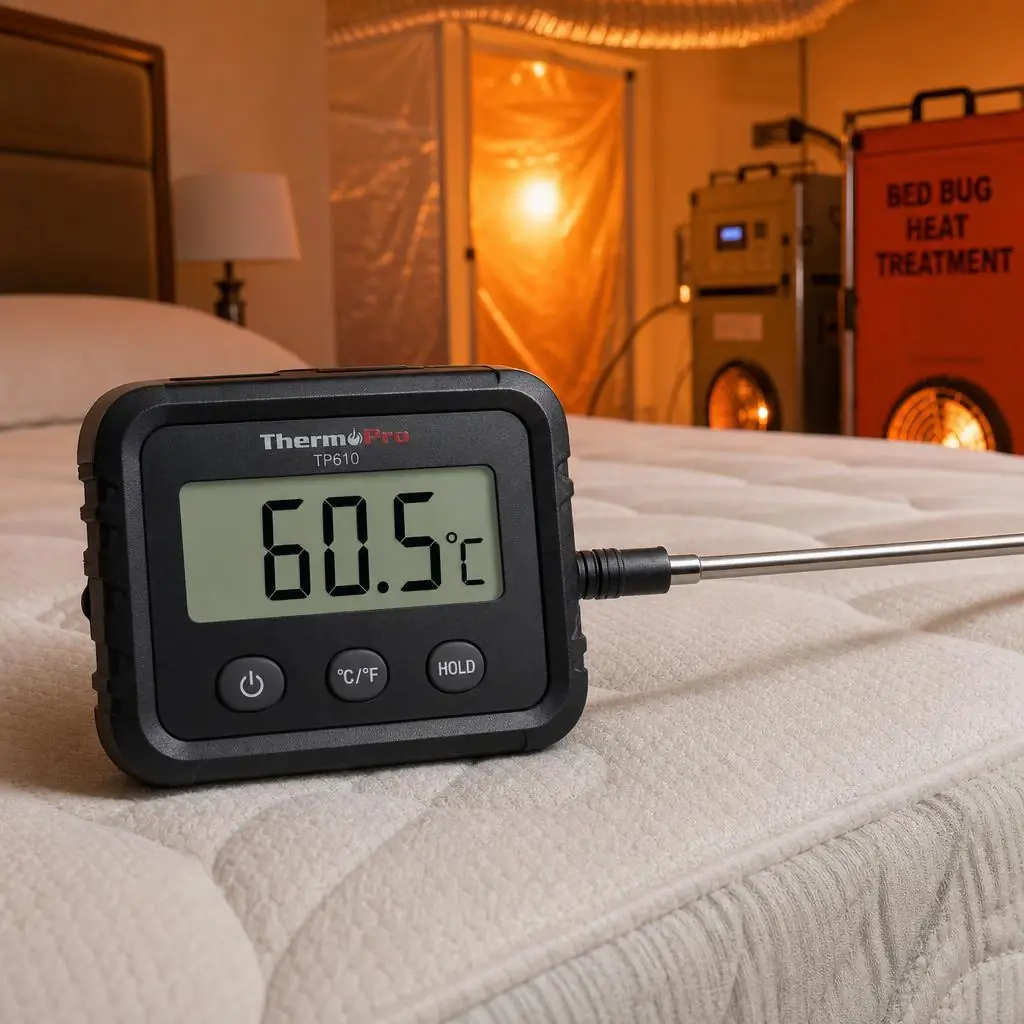
Bed bugs and their eggs die when exposed to sustained temperatures of around 45–50°C, but professional heat treatment operates at a higher air temperature of 60–65°C to guarantee that the coolest hidden points in a room still reach the lethal threshold. Holding these temperatures for at least 90 minutes ensures heat penetrates mattresses, sofa frames, skirting voids and wardrobe joinery. Brief spikes are not enough; it is the combination of correct temperature and adequate hold time that delivers reliable bed bug control. Domestic equipment simply cannot replicate these conditions safely, which is why DIY heat attempts so often fail.
Does heat kill bed bug eggs?
Yes, and this is one of the biggest advantages of professional heat treatment. Bed bug eggs are protected by a waxy shell that resists most liquid insecticides, which is why chemical-only treatments so often fail and an infestation rebuilds a week or two later. Sustained heat at 60–65°C bypasses this defence entirely, denaturing proteins inside the egg and killing the embryo. Adults, nymphs and eggs all die in the same treatment cycle, which means a single, correctly delivered heat treatment can eradicate an entire infestation without the need for follow-up spraying or repeat visits.
How long does heat treatment take?
A typical residential bed bug heat treatment takes between four and eight hours from start to finish, depending on the size of the property, the level of clutter and the construction of the building. Smaller flats can often be completed in around four hours, while larger family homes take longer because more rooms and furniture need to reach the lethal core temperature. The heat-up phase takes one to two hours, followed by at least 90 minutes at temperature and then a cooling period. In most cases customers can return home the same evening with no overnight stay required.
Is heat treatment safe?
Yes, heat treatment is one of the safest professional pest control options available. Because it uses no chemicals, there are no toxic residues left in the property afterwards, which makes it ideal for households with children, pregnant women, pets or anyone with sensitivities. Items at risk of damage, such as candles, aerosols, certain medicines, vinyl records and some electronics, are removed beforehand following a clear pre-treatment list. The property is unoccupied while the heat is on, and our technicians monitor temperatures continuously to keep the treatment within the safe operating range for the building.
Why is heat treatment effective?
Heat treatment is effective because it attacks the one weakness shared by every bed bug life stage: vulnerability to sustained high temperatures. Unlike insecticides, which struggle to penetrate eggs and which bed bugs have evolved resistance to, heat reaches every hidden harbourage simultaneously. Mattresses, sofa frames, electrical sockets, skirting voids and wardrobe joinery all reach lethal temperatures at the same time, leaving nowhere for bugs to retreat to. This is why a single, properly delivered heat treatment so often ends an infestation that has resisted multiple rounds of chemical bed bug treatment elsewhere.
Can heat treatment kill insecticide-resistant bed bugs?
Yes, and this is one of the strongest arguments for using heat as a first-line treatment. Many UK bed bug populations are now highly resistant to the pyrethroid insecticides that were the industry standard for decades, which is why spray-only treatments frequently fail. Resistance is irrelevant under heat: bed bugs cannot adapt their physiology to survive 60–65°C sustained for 90 minutes. This makes professional bed bug heat treatment particularly valuable for stubborn infestations that have already had two or three rounds of chemical treatment without success, including those in flats, HMOs and student accommodation.
Why do some chemical bed bug treatments fail?
Chemical treatments fail for three main reasons. First, widespread insecticide resistance means many UK bed bug populations are no longer affected by standard pyrethroids. Second, eggs are protected by a waxy shell that most sprays cannot penetrate, so even a successful treatment of adults leaves the next generation alive. Third, sprays only reach surfaces a technician can physically treat, and bugs hidden deep inside mattresses, sofas, sockets and skirting voids often survive. By contrast, professional heat treatment for bed bugs reaches every harbourage simultaneously and kills every life stage in a single visit, which is why so many customers turn to heat after chemicals have failed.
Are bed bugs resistant to insecticides?
Many UK bed bug populations are now resistant to the pyrethroid insecticides that have been the industry standard for decades. Resistance develops because surviving bugs pass on protective traits to the next generation, and with bed bugs reproducing quickly this happens within a few generations. Studies in London and other major cities have repeatedly confirmed high resistance levels. This is one of the main reasons spray-only treatments often need to be repeated three or four times, with mixed results. Heat treatment bypasses resistance entirely because bed bugs simply cannot survive sustained temperatures of 60–65°C, regardless of their genetic makeup.
How many chemical bed bug treatments are usually needed?
When chemicals alone are used, eradication typically requires two or three visits spaced two to three weeks apart, and stubborn infestations may need four or more rounds. The reason is biological: most sprays do not reliably kill eggs, so follow-up visits are needed to treat newly hatched nymphs before they reach breeding age. Each visit means more preparation, more disruption and more time living with the infestation. Single-visit heat treatment removes this cycle by killing adults, nymphs and eggs in one day, which is why so many customers choose it after the first or second round of sprays has failed.
How do professionals find bed bugs?
Professional bed bug inspections combine visual surveys, bright torches, magnifiers and probing tools to check every likely harbourage. We focus first on the bed itself, then on bedside furniture, sofas, skirting boards, electrical fittings and any upholstered seating. We look for live insects, shed skins, eggs and the characteristic dark faecal spots that bed bugs leave on fabric. In some cases monitors or canine detection can be used to confirm low-level activity. A trained eye will reliably find an infestation that a homeowner has missed for weeks, which is why a professional inspection is the best starting point if you suspect bed bugs.
What equipment is used for bed bug heat treatment?
We use industrial indirect diesel heaters and American electric heat machines, high-volume air movers and a network of wireless temperature sensors. The heaters generate the warm air, the fans circulate it so every corner of the room reaches the same temperature, and the sensors confirm that even the coolest hidden points have reached lethal levels. We also bring power distribution kit, ducting, thermal imaging cameras and inspection tools so we can monitor and respond in real time throughout the treatment. This professional setup is what allows us to guarantee single-visit eradication, something domestic heaters and DIY methods cannot achieve safely or reliably.
Do I need to leave my property during heat treatment?
Yes, the treated area must be vacated during the heat phase for safety reasons. Most customers leave for the day and return the same evening once the property has cooled. Pets, plants and any items on the pre-treatment removal list also need to be out of the treated zone before we start. In larger properties where only certain rooms are being treated, the rest of the home may remain accessible depending on the layout. Your technician will go through the plan in detail before the day so you know exactly when you can leave and return.
How soon can I return home after heat treatment?
In most cases you can return on the same evening as the treatment, once the property has cooled to a comfortable temperature. There are no chemical residues to ventilate, no airing-out period and no need to wash bedding or clothing that was left in place. Some customers prefer to return after a couple of hours of cooling for comfort, but there is no safety requirement to stay away overnight. This rapid turnaround is one of the key advantages of professional heat treatment for bed bugs compared with multi-visit chemical programmes.
Is one heat treatment enough to eradicate bed bugs?
In the vast majority of residential cases, one correctly delivered heat treatment is enough to fully eradicate an infestation, including adults, nymphs and eggs. This is the defining advantage of heat over chemicals, which typically require multiple visits. We back this confidence with a written six-month guarantee on residential heat treatments: if live bed bugs are found within the guarantee period, we return and re-treat free of charge. Severe or large-scale infestations in HMOs or commercial premises may occasionally need follow-up monitoring, which we agree with you in advance so there are no surprises.
Are bed bugs dangerous?
Bed bugs are not considered medically dangerous in the way that mosquitoes or ticks are. They are not known to transmit disease to humans, despite extensive research. However, they can cause significant secondary problems, including skin infections from scratched bites, allergic reactions, anaemia in heavily bitten individuals, and serious psychological effects such as anxiety, insomnia and depression. The financial cost of repeated treatments and discarded furniture is also a genuine burden. For these reasons, even though bed bugs are not deadly, an active infestation should always be taken seriously and dealt with through professional bed bug treatment as soon as possible.
Do bed bugs carry diseases?
Current scientific evidence indicates that bed bugs do not transmit disease to humans under normal conditions. Researchers have found traces of various pathogens in bed bug bodies, but no reliable mechanism for passing those pathogens on through a bite. This is a significant difference from mosquitoes, ticks or fleas. That said, the welts left by bed bug bites can become infected if scratched, and the stress of an ongoing infestation can affect physical and mental health. The most reliable way to protect your household is to remove the infestation entirely with professional heat treatment rather than relying on partial solutions.
Can bed bugs make you ill?
Bed bugs do not transmit disease, but they can certainly make you unwell in less direct ways. Repeated bites can cause significant itching and broken skin that becomes infected. People with severe allergic reactions may develop large welts requiring medical attention, and very heavy infestations have been linked to mild anaemia in vulnerable individuals. Beyond the physical, the psychological impact is often the most serious: sleep loss, anxiety, embarrassment and depression are common in households with ongoing infestations. Resolving the infestation quickly with professional bed bug treatment is the single most effective way to protect both physical and mental health.
Can bed bugs affect sleep?
Yes, bed bugs frequently disrupt sleep, even before bites become obvious. Once a person suspects an infestation, anxiety and hypervigilance can make falling and staying asleep extremely difficult. The bugs themselves usually feed in the early hours when the host is in deep sleep, but the resulting itching often wakes people. Long-term sleep loss can affect mood, concentration, immune function and overall wellbeing. Many customers describe a dramatic improvement in sleep within days of a successful heat treatment, simply because they finally feel safe in their own bed again, which is one of the most rewarding parts of our work.
Can pets get bed bugs?
Bed bugs strongly prefer human blood and do not live on pets the way fleas do. They will, however, occasionally bite cats, dogs and rabbits if a human host is not available, and they can shelter in pet beds and cages. Pets do not typically carry bed bugs around the home the way they spread fleas, but pet bedding should still be inspected and washed on a hot cycle as part of any treatment. Our heat treatment is completely safe for use in homes with pets, provided the animals are kept out of the treated area during the heat phase.
Can dogs carry bed bugs?
Dogs can occasionally carry the odd bed bug on their fur or bedding, but they are not a primary vector the way they are for fleas. Bed bugs do not live on dogs and do not lay eggs in their coats. The greater risk comes from dog beds and blankets left near an infested human bed, which can become harbourage points. We recommend including dog beds, soft toys and any washable items in the pre-treatment laundry on a hot wash and tumble dry. Dogs themselves can stay in the home but must be kept out of the treated rooms during the heat phase.
Can cats carry bed bugs?
Cats, like dogs, are not a typical vehicle for spreading bed bugs. The bugs prefer to feed on humans and do not live on a cat's body, although they can occasionally bite if no human is available. The main risk in households with cats comes from cat beds, blankets and favoured sleeping spots on sofas, which can become secondary harbourages. These should be laundered on a hot wash or included in the heat treatment area. Cats themselves must be removed from the property during the heat phase but can return safely the same evening once the property has cooled.
How can I stop bed bugs returning after treatment?
After a successful heat treatment, prevention focuses on three things: monitoring, sealing and vigilance. Use mattress and box-spring encasements to deny bugs hiding places, vacuum bedroom edges weekly and inspect bed seams once a month. Seal visible cracks in skirting boards and around sockets with decorator's caulk. Be careful with second-hand furniture, and always inspect luggage after travel. If you live in a flat or HMO where neighbours may be affected, tell your landlord at the first sign of any new activity. A quick professional re-inspection is far cheaper than treating a second full infestation.
How often should I inspect my bed for bed bugs?
If you have never had bed bugs and have no reason to suspect them, a quick inspection every couple of months is sensible, particularly after travel or visitors. If you have recently had treatment, weekly inspections for the first month and then monthly thereafter give the best early warning. Focus on the mattress seams, the underside of slats, the headboard and the bedside drawer joints, using a torch and ideally a magnifier. Look for live bugs, shed skins, eggs and small dark faecal spots. Spotting a problem early dramatically reduces the cost and disruption of treatment.
Should I use mattress encasements?
Yes, certified bed bug mattress and box-spring encasements are an excellent investment, particularly after a treatment or in higher-risk households such as HMOs and student accommodation. A good encasement traps any bugs or eggs inside, where they cannot feed and eventually die, and it denies new bugs the seams and tufts they prefer to hide in. Look for encasements specifically marketed as bed bug proof, with a zipper guard. They should be left in place permanently. Encasements do not replace professional treatment, but they make ongoing monitoring much easier and reduce the chance of a future infestation establishing itself.
Do you provide bed bug heat treatment in London?
Yes, London is our busiest service area. We cover every borough from central London to the outer suburbs, including flats, period houses, HMOs, hotels and short-let properties. The density of housing and the constant turnover of visitors make London particularly prone to bed bug infestations, and we have years of experience working in challenging access situations including basement flats, high-rises and listed buildings. Same-day and next-day appointments are usually available across the capital, with our specialist heat treatment vans equipped to handle anything from a single bedroom to a multi-storey townhouse in one visit.
Do you cover Hertfordshire for bed bug treatment?
Yes, we provide professional bed bug heat treatment throughout Hertfordshire, including Watford, St Albans, Hemel Hempstead, Stevenage, Hertford, Hatfield, Welwyn Garden City and the surrounding villages. Hertfordshire's mix of commuter towns and rural properties means we see a wide variety of cases, from modern flats to older detached houses. Our single-visit heat treatment is particularly popular with busy commuter families who cannot accommodate repeated chemical visits. Travel within Hertfordshire is included in our standard pricing, so you receive the same fixed-price, chemical-free, six-month guaranteed service wherever you are in the county.
Do you treat bed bugs in Essex?
Yes, we cover the whole of Essex for professional bed bug treatment, including Romford, Chelmsford, Brentwood, Basildon, Southend-on-Sea, Colchester, Harlow and surrounding towns and villages. Essex sees a high volume of bed bug cases driven by commuter travel into London and the constant movement of second-hand furniture through online marketplaces. Our heat treatment vans are based to allow same-day and next-day cover across the county. Whether it is a single-bedroom flat in Basildon or a large family home in Brentwood, we deliver the same single-visit, chemical-free service backed by a written six-month guarantee.
Do you offer bed bug heat treatment in Kent?
Yes, we treat properties across Kent including Bromley, Dartford, Sevenoaks, Tunbridge Wells, Maidstone, Canterbury, Ashford and the Medway towns. Kent has a particularly active short-let and tourism market, both of which contribute to bed bug spread. We use professional heat treatment so customers in listed Kent properties and oast houses do not need to worry about chemical residues or repeat visits. Travel time across Kent is included in our standard pricing, and same-day or next-day appointments are usually available depending on technician availability. Every treatment is backed by a six-month written guarantee for residential customers.
Can you treat bed bugs in Surrey?
Yes, we cover the whole of Surrey, from Kingston, Croydon and Sutton in the north through Guildford, Woking, Epsom and Reigate to the more rural villages further south. Surrey's mix of high-value family homes and busy commuter flats means we treat everything from compact one-bed apartments to large detached houses in a single visit. Our chemical-free heat treatment is particularly popular with families who do not want pesticides used around children or pets. Same-day appointments are often available across Surrey, with every treatment backed by a written six-month guarantee on residential properties.
Do you provide bed bug services in Buckinghamshire?
Yes, we serve the whole of Buckinghamshire, including High Wycombe, Aylesbury, Amersham, Beaconsfield, Chesham, Marlow and Milton Keynes. The county's strong commuter links into London mean bed bugs are frequently brought home from trains, hotels and offices, and we see a steady flow of cases from both apartments and family houses. Our heat treatment is a particularly good fit for the listed and period properties common in towns like Amersham and Marlow, because it leaves no chemical residue and reaches into every cavity. Every Buckinghamshire treatment is fixed-price with a written six-month guarantee.
How quickly can you arrange a bed bug heat treatment?
We aim to offer same-day or next-day appointments across most of our coverage area, including London and the home counties. After your initial phone call or online enquiry, a specialist will run through your symptoms, the size of the property and any access constraints, then book a slot that suits you. In urgent cases, particularly where bites are heavy or children are affected, we will do everything possible to attend within 24 hours. For non-urgent jobs, including landlord turnover work and short-let preparation, we can book a few days ahead to suit your schedule.
How much does professional bed bug heat treatment cost?
Pricing depends on the size of the property and the number of rooms being treated rather than the severity of the infestation. We quote a single fixed price per property after a short phone consultation, with no hidden extras and no follow-up visit charges within the guarantee period. A typical single-bedroom flat sits at the lower end of our pricing, while larger family homes cost more because more equipment and time are needed. The fixed price always includes a written six-month residential guarantee and a free re-treatment if live bed bugs are found within that period.
Do you offer a guarantee with bed bug treatment?
Yes, every residential heat treatment we carry out is backed by a written six-month guarantee. If live bed bugs are confirmed within that period in any room we treated, we return and re-treat free of charge. The guarantee is based on the fact that a correctly delivered heat treatment kills all life stages in one visit, so genuine reinfestation is rare. The guarantee does not cover new infestations introduced from outside the property, for example via luggage from a separate trip, but in practice the vast majority of our customers never need to use it.
Is heat treatment safe for children and pregnant women?
Yes, because no chemicals are used, heat treatment is one of the safest options available for households with children and expectant mothers. There are no toxic residues, no airborne pesticide droplets and no chemical odour to ventilate afterwards. The treated rooms must be vacated during the heat phase for general safety reasons, but the family can return the same evening once the property has cooled. We always confirm pre-treatment removal items and access arrangements with you in advance, taking particular care to handle medicines, baby formula and other temperature-sensitive items appropriately.
Is heat treatment safe around pets?
Heat treatment itself is entirely chemical-free, which makes it a far better option than insecticides for households with pets. Cats, dogs, rabbits and any other animals must be removed from the treated zone during the heat phase, just as people are, and provision must be made for fish tanks and reptile vivaria that cannot be exposed to high temperatures. Once the property has cooled, pets can return immediately with no need for the airing-out period that follows a chemical treatment. We will run through pet-specific arrangements with you when booking the appointment.
Can I treat bed bugs myself with DIY heat?
DIY heat is rarely effective and can be dangerous. Domestic heaters cannot raise an entire room to 60–65°C and hold it long enough to reach the coolest hidden harbourages, so bugs and eggs survive in mattress cores, sofa frames and skirting voids. Garment steamers and irons can kill bugs on contact, but they reach only a tiny fraction of the harbourage. Worse, attempts to use heaters or open flames to raise temperatures have caused house fires. Professional heat treatment uses controlled industrial equipment, monitored temperatures and trained technicians, which is why it succeeds where DIY almost always fails.
Will I need to throw away my mattress?
Usually no. One of the biggest advantages of professional heat treatment is that mattresses, sofas and other upholstered furniture can be saved rather than dumped. Hot air penetrates the entire mattress to a lethal core temperature, killing every bug and egg without damaging the fabric or fillings. The only mattresses we recommend discarding are those that are heavily soiled, badly damaged or already at the end of their useful life. After treatment, a quality bed bug encasement provides added peace of mind and protects against any future hitchhikers from luggage or visitors.
How do I prepare for a bed bug heat treatment?
We send a clear preparation checklist as soon as you book. In short, you remove items that could be damaged by heat, such as candles, aerosols, certain medications, vinyl records, chocolate and some plastics. Bedding and clothing on the bed can usually stay in place, but loose laundry is best bagged and washed afterwards. You do not need to dismantle the bed or move furniture, as the treatment works around the existing layout. Most customers find the preparation takes a couple of hours the day before, and our technicians are happy to answer questions before treatment day.
Will heat treatment damage electronics or furniture?
Properly delivered heat treatment uses temperatures within the safe operating range of almost all modern furniture and most consumer electronics. Solid wood, upholstered furniture, mattresses, books and bedding all tolerate the treatment well. A small number of items do need to be removed beforehand, including pressurised cans, candles, certain plastics, vinyl records, some medications and items of significant sentimental value made of wax or low-melt materials. Your pre-treatment checklist sets all of this out in detail, and your technician will run through it on the day so nothing valuable is at risk.
Will my neighbours be affected by heat treatment?
Heat treatment is contained within your property, so neighbours are not directly affected by the heat itself. There are no chemical odours or residues, no need for them to leave their homes and no requirement to ventilate adjoining flats. In blocks where the original infestation has spread between units, however, neighbouring flats may already have bed bugs and ideally should also be inspected. We are happy to liaise with managing agents and landlords to coordinate treatments across multiple flats, which is the most reliable way to prevent reinfestation from a shared wall, ceiling or service void.
Can heat treatment be used in flats and apartments?
Yes, the majority of our work in central London and the home counties is in flats and apartments, ranging from studio bedsits to multi-bed mansion flats. Our equipment is portable and can be carried up stairs or used in lifts, and the heat is contained within the treated unit. We work closely with managing agents in larger blocks to confirm access, parking and electrical capacity in advance. For purpose-built blocks with a history of bed bug issues across multiple units, we can also coordinate treatments of neighbouring flats so the building is dealt with as a whole.
Do you treat HMOs and student housing for bed bugs?
Yes, HMOs and student properties are a regular part of our work. The high turnover of tenants and the volume of second-hand furniture mean these properties are particularly vulnerable to bed bug infestations. We coordinate with landlords, letting agents and accommodation providers to treat affected rooms quickly with minimal disruption to other tenants. Single-visit heat treatment is ideal here, because it avoids the repeat chemical visits that are particularly disruptive in shared housing. We also provide clear written documentation for landlord records, which is useful for compliance and for managing tenant communications.
Do you offer bed bug treatment for hotels and serviced apartments?
Yes, we work with independent hotels, hotel groups, serviced apartments and short-let operators across London and the South East. Discretion, speed and minimal disruption are central to how we work in commercial accommodation. We treat affected rooms in a single visit so the unit can be back in service the same evening, and we provide written documentation suitable for guest reassurance and internal compliance. For larger hotels, we can put proactive inspection and rapid-response treatment programmes in place, helping to contain any incident before it spreads to neighbouring rooms or attracts negative reviews.
Do you treat short-let and Airbnb properties for bed bugs?
Yes, short-let and Airbnb properties are a growing part of our work, particularly in London, Kent and Surrey. The frequent guest turnover means infestations can establish quickly, often without the host realising until a negative review appears. Single-visit heat treatment is ideal because the property can be back online the same evening with no chemical residues and no need for re-treatment visits. We provide written documentation for your records and can advise on simple preventative measures such as encasements, inspection routines and laundering protocols to reduce the chance of repeat problems.
Do you provide bed bug treatment for landlords?
Yes, landlords across our coverage area regularly use our services for both reactive treatments and turnover preparation between tenancies. We offer fixed-price quotes, fast appointment slots and clear written documentation suitable for letting agents, insurance claims and tenant communication. Single-visit heat treatment is particularly attractive to landlords because it minimises void periods compared with multi-visit chemical programmes. We can also coordinate treatments across multiple properties in a portfolio and provide ongoing inspection options for higher-risk units such as HMOs and short-lets, helping you stay ahead of issues before they generate tenant complaints.
Can bed bugs survive cold weather?
Bed bugs are remarkably tolerant of cold and can survive normal British winter temperatures inside heated homes without difficulty. Even in unheated outbuildings or empty flats, they slow their metabolism and can survive for many weeks. Sustained sub-zero temperatures will eventually kill them, but only after several days of continuous freezing, which is rarely achievable in indoor conditions. Placing infested items outside in winter is not a reliable treatment method. The only consistently effective non-chemical approach is sustained heat at 60–65°C, which kills every life stage in a single cycle regardless of the time of year.
Can bed bugs be killed by washing clothes?
Yes, washing clothes on a hot cycle of at least 60°C, followed by a high-heat tumble dry for 30 minutes, will reliably kill all life stages of bed bugs hidden in fabric. The tumble dry stage is particularly important because it kills eggs that may have survived the wash. Items that cannot be hot washed, such as wool, silk or delicate fabrics, can often be tumble dried alone on high heat, which still kills bugs and eggs. Hot laundry is an excellent complement to professional bed bug heat treatment, especially for items packed in luggage after travel.
Will a vacuum cleaner remove bed bugs?
Vacuuming is a useful supporting measure but is not a standalone treatment. A powerful vacuum with a crevice tool will physically remove visible bugs and some eggs from mattress seams, skirting edges and upholstered furniture, reducing the population temporarily. However, eggs glued tightly into seams often resist suction, and many harbourages are simply unreachable. The vacuum bag or canister contents must be sealed in plastic and disposed of outside immediately to prevent escape. Used alongside professional heat treatment, regular vacuuming helps with post-treatment monitoring and reassurance, but it cannot replace the lethal heat needed for eradication.
Do bed bug sprays from supermarkets work?
Over-the-counter bed bug sprays sold in supermarkets and DIY stores are generally too weak to deal with an established infestation. They may kill the occasional bug on contact, but they do not penetrate eggs, do not reach deep harbourages and often drive bugs to spread further through the property as they try to escape. Many UK populations are also resistant to the active ingredients used. By the time most customers call us, they have already tried DIY sprays without success. Professional heat treatment is far more reliable and avoids the chemical exposure that comes with repeated DIY spraying.
Can essential oils kill bed bugs?
Essential oils such as tea tree, lavender and peppermint are widely promoted as natural bed bug remedies, but the evidence does not support them as a reliable treatment. Some oils can kill bed bugs on direct contact in laboratory tests, but they do not penetrate eggs, do not reach hidden harbourages and evaporate too quickly to provide lasting control. They may temporarily mask early signs of activity and delay people seeking professional help, which usually makes the infestation worse. If you are committed to a chemical-free approach, professional heat treatment is by far the most effective option.
Do bed bug bombs or foggers work?
Foggers and bug bombs are generally a poor choice for bed bugs. The pesticide droplets settle only on exposed surfaces and do not penetrate the deep cracks, mattress seams and joinery where bed bugs actually live. Foggers can also drive bugs to spread into walls and adjoining rooms in their attempt to escape the irritant, making the infestation harder to control. Many UK bed bug populations are resistant to the active ingredients used. Professional heat treatment is dramatically more effective because heat reaches everywhere at once, leaving nowhere for bugs to escape to.
How do I tell the difference between bed bugs and fleas?
Bed bugs and fleas can both leave itchy bites but differ in important ways. Adult fleas are tiny, dark and jump several inches when disturbed; bed bugs are larger, flatter and crawl rather than jump. Flea bites usually cluster around ankles and lower legs, while bed bug bites favour areas exposed during sleep such as arms, neck and back, often in straight lines or small clusters. Fleas need a pet host to sustain a population in most homes; bed bugs feed only on humans. If in doubt, a professional inspection is the fastest way to identify exactly what is biting.
How do I tell the difference between bed bugs and carpet beetles?
Carpet beetles are small, rounded and often mottled brown, black and cream, with hard wing cases. Their larvae are tiny hairy 'woolly bears' that feed on natural fibres rather than blood. Bed bugs are flat, oval and reddish brown, with no wing cases and no hairy larvae. Carpet beetles cause damage to wool carpets, sheepskin rugs and natural-fibre clothing, while bed bugs leave bite marks on people and dark faecal spots near beds. The two are sometimes confused at a quick glance but a torch and close inspection, or a professional visit, will distinguish them reliably.
Can bed bugs live in cars?
Yes, bed bugs can survive in cars, particularly in vehicles regularly used to transport infested items such as luggage, bedding or second-hand furniture. They shelter in seat seams, under carpets and within the cracks of door cards. Population numbers in cars are usually small because there is no overnight host, but a single fertilised female can be enough to seed a new infestation in your home. Vehicles can be treated with professional portable heat units, or by leaving items inside in summer with the windows shut, though this method is far less reliable than controlled professional heat treatment.
Can bed bugs live in offices?
Bed bugs can establish in offices, although it is less common than in homes because nobody sleeps there. They typically arrive on coats, bags or visitors from infested homes and shelter in upholstered chairs, sofas, soft partitions and storage cupboards. They occasionally bite staff during the day if conditions allow. Offices with shared lockers, sleep pods or sofa areas are most at risk. Heat treatment can be applied to specific rooms or items rather than the whole building, which makes it a practical option for commercial premises that need to minimise disruption to normal working hours.
Can bed bugs live in cinemas, trains or buses?
Bed bugs can survive in cinemas, trains and buses, particularly within fabric seating and the gaps between cushions. They are unlikely to establish a permanent population because there is no overnight host, but they readily hitchhike onto passengers and travel home in coats, handbags and rucksacks. This is one of the main reasons bed bugs spread through cities even when individual properties have no obvious source. Operators of public seating areas often arrange routine professional heat treatment of vehicles and venues to keep populations under control and protect their reputation.
Why are bed bugs becoming more common in the UK?
Bed bug numbers in the UK have risen sharply over the past two decades, driven by several factors. Increased international travel brings bugs home in luggage, the boom in short-let accommodation creates many high-turnover rooms, and widespread resistance to common insecticides has reduced the effectiveness of traditional chemical treatments. Online marketplaces also move enormous volumes of second-hand furniture between homes. Combined, these trends mean almost any household can be exposed regardless of cleanliness or location. Professional heat treatment has become increasingly important precisely because it bypasses the resistance issue that hampers chemical approaches.
Can bed bugs come from second-hand furniture?
Yes, second-hand furniture is one of the most common sources of new bed bug infestations. Mattresses, sofas, bed frames, headboards and even dining chairs can harbour live bugs and eggs that survive in the item for months. Before bringing any second-hand piece into your home, inspect it thoroughly with a torch, paying close attention to seams, joints and the underside. If in doubt, ask for professional heat treatment of the item before installation, or simply choose a different piece. Furniture left on the street for free collection should generally be avoided altogether for this reason.
Should I throw out infested furniture?
In most cases no. Modern professional heat treatment kills bed bugs and eggs inside mattresses, sofas and bed frames without damaging the furniture, so the vast majority of items can be saved. We only recommend discarding furniture that is already heavily soiled, structurally damaged or at the end of its useful life. If you do choose to discard an infested item, wrap it in plastic or label it clearly as infested before putting it out, so nobody else takes it home and seeds a new infestation. Heat treatment usually works out cheaper than replacing a bed and sofa.
Can I sleep in my bed during a bed bug infestation?
It can feel counter-intuitive, but in most cases it is best to keep sleeping in your usual bed until professional treatment takes place. Moving to a sofa, spare room or another property simply gives the bugs a new feeding location and risks spreading the infestation, while the original harbourage remains active. Use mattress encasements if you have them, keep bedding off the floor and avoid storing bedside clutter that creates new hiding places. After successful heat treatment, customers usually feel completely safe in their own bed again within a single night.
Do I need to wash all my clothes after a bed bug infestation?
Washing clothes and bedding on a hot cycle is a sensible part of dealing with a bed bug infestation, especially items stored in or near the bed. After professional heat treatment, items already in the treated rooms have themselves been heated to lethal temperatures and do not strictly need re-laundering, although many customers prefer to do so for peace of mind. Items packed into bags before treatment, or moved to another property, should be hot washed and tumble dried at high heat before being returned, to be sure no surviving bugs travel back into the treated space.
Is bed bug heat treatment available at weekends?
Yes, we offer weekend appointments wherever possible across our coverage area, including Saturdays and selected Sundays. Weekend slots are particularly useful for working families, busy hotels and short-let operators who cannot easily arrange weekday access. Slots are limited and tend to book up quickly, so contacting us as early in the week as possible gives the best chance of securing a preferred time. Weekend pricing is the same as our weekday rate, and the same written six-month residential guarantee applies. Out-of-hours and overnight treatments can be arranged for commercial premises by prior agreement.
How do I book a bed bug heat treatment?
Booking is straightforward. Call our specialist team on the number at the top of every page, or complete the short callback request form on the website and we will ring you back at a time that suits you. We will ask a few quick questions about the property size, the rooms affected and any access constraints, then confirm a fixed price and an appointment slot. Most customers are booked in within minutes, with same-day or next-day visits available across most of London and the home counties. There is no obligation and no charge for the initial phone consultation.